
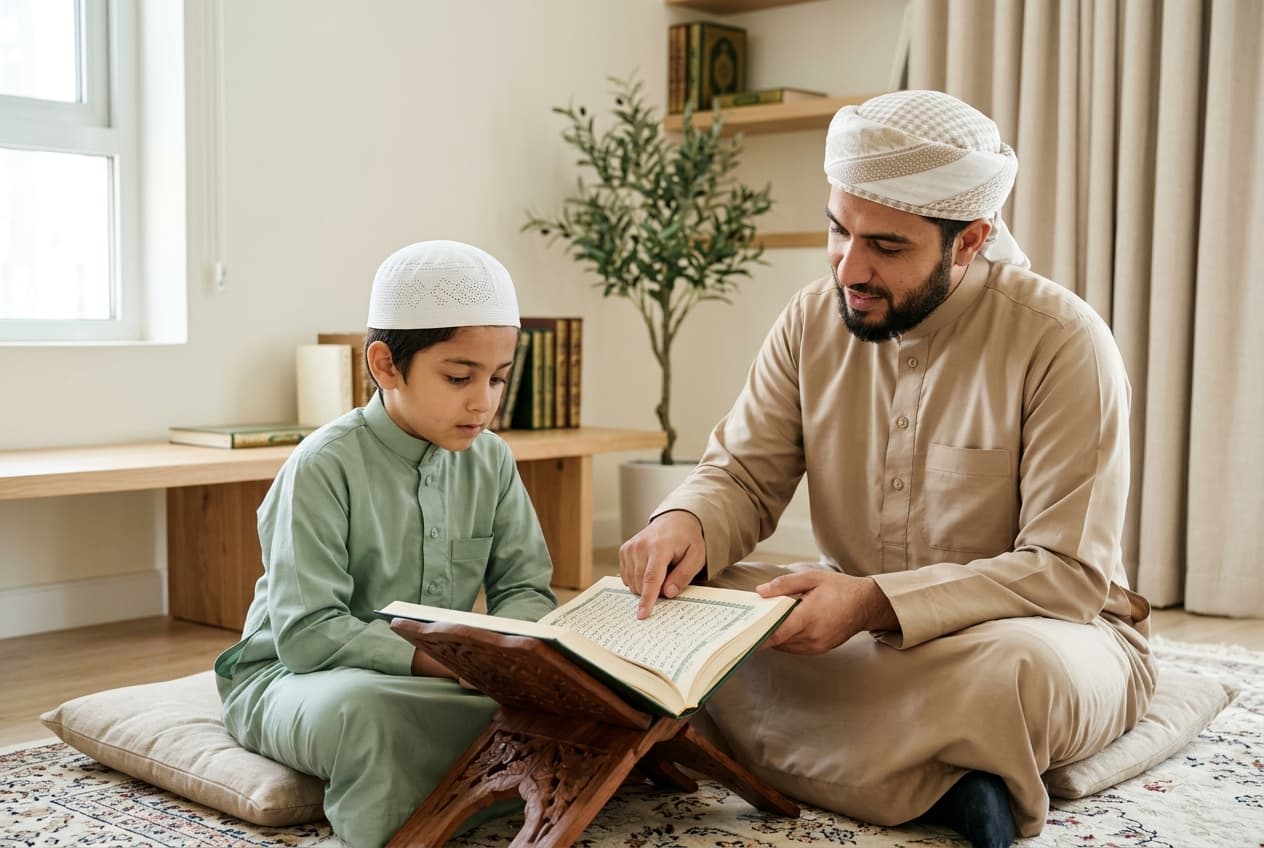
A patient, step-by-step guide for beginners, from Arabic letters and pronunciation to daily practice and learning with a qualified Quran teacher.
Introduction
Reading the Quran in its original Arabic, with correct pronunciation, is a skill that many Muslims hope to build. It is also a skill that can feel overwhelming when you are starting from zero, because the letters look unfamiliar and the sounds are new.
If you are wondering how to learn Quran for beginners, the good news is that Quran reading is learned in stages. You do not need to master every rule before you open a Quran. Most beginners progress by learning a small number of things at a time and practising them until they feel comfortable, then moving on.
This guide walks through that process: the Arabic alphabet, pronunciation, the vowel signs, joining letters into words, Tajweed, a practical daily routine, common mistakes, and the role of a qualified teacher. It is written for adults and for parents who are helping children begin.
1. Start by Learning the Arabic Alphabet
Arabic has 28 letters. It is written from right to left, and most letters connect to the letters beside them. Because of this, the same letter can look slightly different depending on where it appears in a word.
A letter usually takes one of four forms: standing alone, at the beginning of a word, in the middle of a word, or at the end. Some letters do not connect to the letter that follows them, and beginners should learn this early so that they do not expect every letter to join.
A helpful first goal is to recognise each letter's shape and name before worrying about how it sounds inside a word. Many learners find it easier to study the alphabet in small groups of letters that share a base shape and differ only by their dots, rather than trying to memorise all 28 at once.
2. Learn the Correct Pronunciation of Arabic Letters
Pronunciation is central to reading Arabic correctly. Some letters that look or sound alike to a beginner are distinct in Arabic, and the difference can change the meaning of a word. Learning to hear these differences takes attention and practice.
Scholars of recitation describe where each letter is produced in the mouth and throat, using the term Makharij, which means articulation points. You do not need to memorise a technical chart on your first day, but understanding the idea helps you see why a letter sounds the way it does and how to correct it.
Because you cannot easily hear your own pronunciation, a qualified teacher is especially valuable at this stage. A teacher can listen, point out a sound that is slightly off, and show you how to adjust the position of your tongue, throat, or lips. Recordings can help you listen, but they cannot correct your own articulation.
3. Understand Harakat and Basic Reading Signs
Quranic script uses short vowel marks called harakat, which are written above or below the letters. Three of them are the most important for beginners:
- Fathah, taught as Zabar in many South Asian learning contexts, gives a short "a" sound. It is written as a small diagonal stroke above the letter.
- Kasrah, taught as Zer, gives a short "i" sound. It is written as a small stroke below the letter.
- Dammah, taught as Pesh, gives a short "u" sound. It is written as a small curl-shaped mark above the letter.
These signs change how a word is read, so reading them carefully matters as much as recognising the letters. The same consonants with a different vowel can produce a different word.
Two further signs are introduced early, once the vowels feel natural:
- Sukoon is a small circle written above a letter. It shows that the letter has no vowel after it.
- Shaddah is a small mark shaped like a little "w". It shows that a letter is doubled and should be pronounced with a clear, held emphasis.
Do not try to master every sign in one week. Start with the three main vowel marks, practise them until they are reliable, and then add Sukoon and Shaddah.
4. Learn to Join Letters and Read Words
A sensible progression moves from single letters to short combinations, then to simple words, and later to longer words and phrases from the Quran. Each stage builds on the one before it. A learner who is still unsure of letter shapes will find long words frustrating.
Begin by joining two letters with a vowel, then three, and then reading short words that you already recognise. Reading slowly, sounding out each letter and then blending them together, is more effective than trying to read quickly.
Progress is often uneven. Some weeks will feel quick, and others will seem to stall. This is normal. A slow week usually means it is time to revisit the basics, not that you have failed.
5. Understand Why Tajweed Matters
Tajweed refers to the rules of correct recitation. The word itself means to make something good or proper. Tajweed covers how each letter should be pronounced, how long certain sounds are held, where a reader may pause, and how letters blend in continuous recitation.
For a beginner, Tajweed does not need to start as a long list of rules. A teacher usually introduces its principles gradually and connects each one to the reading you are already doing. This helps learners understand why their recitation changes, rather than memorising rules in isolation.
If you want to learn to read Quran with Tajweed in depth, our Quran Reading & Tajweed course is designed for that purpose. You can find it in the course links below.
6. Practise Listening and Reading Together
Listening to a reliable reciter while following the written text can help you connect sounds with letters. Hearing how a word flows, where a reader stops, and how long a sound is held gives you a model to imitate.
Listening works best as a companion to learning, not as a replacement for it. A recording cannot hear your mistakes or correct the position of your tongue. Use recordings to reinforce what you learned with a teacher, and check your own recitation with a qualified teacher regularly.
A simple method is to listen to a short passage once while following the text, then recite it yourself one phrase at a time, pausing after each. Repeat until your reading sounds closer to the recording.
7. Follow a Simple Daily Practice Routine
A realistic routine is short and consistent. Many learners do better with 15 to 30 minutes on most days than with one long session each week. Adjust the length to suit your schedule and energy.
A practical session might include:
- Letter recognition: reviewing a few letters and their forms.
- Pronunciation: saying each letter aloud and listening carefully for differences.
- Vowel practice: reading short combinations and words with the vowel marks.
- Reading with feedback: reading a short passage, ideally with a teacher or a recording, and noting the sounds to correct.
- Revision: returning to earlier material before adding anything new.
Keep the routine flexible. On a busy day, a few minutes of revision still count. If a section feels too difficult, step back to the previous stage rather than pushing forward. Avoid setting a fixed finish date for yourself, because progress depends on your starting point and how much you practise.
8. Common Mistakes Beginners Should Avoid
Most beginners face the same few difficulties. Recognising them early makes them easier to fix.
- Rushing ahead before recognising the letters. Reading longer words before the letter shapes are familiar leads to guessing rather than reading.
- Overlooking pronunciation. Letters that look similar are easy to confuse, and small errors repeated every day can become habits.
- Practising inconsistently. Short daily practice is usually more effective than occasional long sessions, because memory fades between them.
- Ignoring feedback. A teacher's correction is most useful when you apply it straight away and repeat it until it feels natural.
- Attempting advanced rules too early. Detailed Tajweed rules are easier to learn once the letters and vowels are secure.
These are practical learning difficulties, not signs that a learner lacks sincerity or effort. Most of them are straightforward to correct with patient, structured practice.
9. Can Adults Learn to Read the Quran?
Yes. Many adults choose to learn to read the Quran later in life, and they often bring focus, maturity, and clear goals to their studies. Starting from the alphabet is a normal beginning, and experienced teachers are used to working with learners at every stage.
Adults often have busy schedules, so a structured plan with short, regular sessions tends to work well. Setting a modest weekly goal, such as learning one group of letters, and reviewing it regularly keeps steady progress manageable.
Each learner's background, language ability, and available time are different, so progress will vary. Comparing yourself with others is less helpful than measuring your own progress from one month to the next.
10. How Parents Can Help Children Learn
Children learn best in a calm and encouraging environment. A regular practice time, kept short enough that the child stays focused, helps build a habit that lasts.
- Keep sessions short and end while your child is still engaged. Brief, regular practice is often more effective than long sessions.
- Praise effort and steady progress, not only perfect recitation.
- Choose instruction that suits your child's age and learning style, and that includes correction as well as listening.
- Use flashcards, simple games, or small rewards for recognising letters, while keeping the focus on respect for the Quran.
- Avoid comparing your child with siblings or classmates. Children progress at different rates.
- Be patient with mistakes. Correct them gently, model the right sound, and ask your child to repeat it.
Parents do not need to be experts to help. Sitting with your child during practice, listening while they read, and celebrating small achievements can make a real difference, especially when the child sees that the family values the lessons.
11. Should Beginners Learn with a Quran Teacher?
A qualified Quran teacher offers something that a book or recording cannot fully provide: individual feedback. A teacher can hear your pronunciation, identify the specific error, and guide you to correct it. This matters most for letters that a beginner struggles to tell apart.
A good teacher also provides structure. Lessons are arranged so that each step builds on the last, with regular review. Learners who study alone may skip difficult areas without noticing, while a teacher can spot these gaps and return to them.
When choosing a teacher, look for recognised training in Quran recitation, a clear lesson structure, patience with beginners, and an explanation of how they correct mistakes. Ask about their background and method, and where possible, try a trial lesson before committing.
If you want to learn to read Quran online, online learning is one effective option, particularly for learners who live far from a suitable teacher or whose schedules are limited. It is not the only valid way to learn. Many people learn well in a local class, at a mosque, or with a family member who has the necessary training. What matters most is regular instruction, correction, and practice.
12. Frequently Asked Questions
Begin with the Arabic alphabet: the shapes, the names, and the basic sounds of the letters. Then add the vowel marks and practise reading short combinations. Ideally, check your pronunciation with a qualified teacher from the start.
Yes. Reading is a separate skill from understanding. Many learners first learn to read the letters and recite the text, and study the meaning separately through translation and explanation as their knowledge grows.
It depends on your starting point, how much time you can practise, and whether you have regular instruction. Some learners progress within a few months, while others take longer. Focus on steady, consistent progress rather than a fixed deadline.
Most teachers introduce basic Tajweed alongside reading rather than as a full course to complete first. Start with letters and vowels, and let your teacher add Tajweed principles gradually as your reading becomes more confident. Questions about religious rulings are best directed to a qualified scholar.
Yes. Adults can begin at any stage of life and often benefit from a structured, patient approach. Progress depends on practice, good instruction, and the time available rather than on age alone.
Yes. A teacher can correct pronunciation, introduce rules in a manageable order, and help you stay consistent. Learning from a qualified teacher is especially valuable for beginners who cannot yet hear their own mistakes.
Conclusion
Learning to read the Quran is a gradual process built from small, repeated steps: recognising letters, pronouncing them correctly, mastering the vowel marks, joining letters into words, and practising regularly with feedback. There is no need to rush, and steady effort matters more than speed.
Whether you are beginning as an adult or helping a child, approach the learning with patience and respect for the text. If you would like structured guidance, you can explore the Quran reading lessons offered by Taleem Quran Sunnah Academy and take the first step at your own pace.